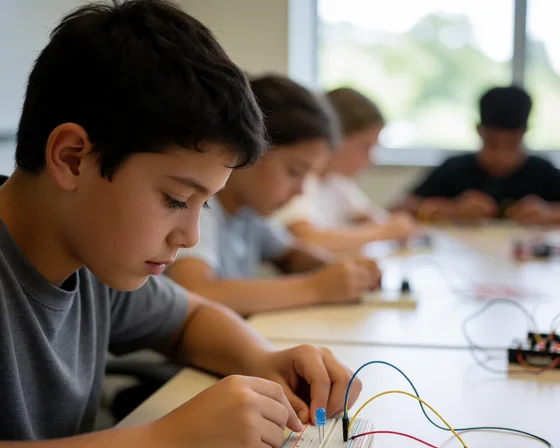
They learn to find faults
A working circuit is easy. We teach the method for when it doesn't work — check the middle, halve the problem, keep going. It works on anything that breaks.
Breadboard electronics · Ages 10–14 · Northern Gold Coast
We teach the process of designing and building hand crafted breadboard electronics — what each component actually does, so your child can design their own circuits instead of following somebody else's instructions.
Classes of 12No solderingNo mains powerFirst lesson free
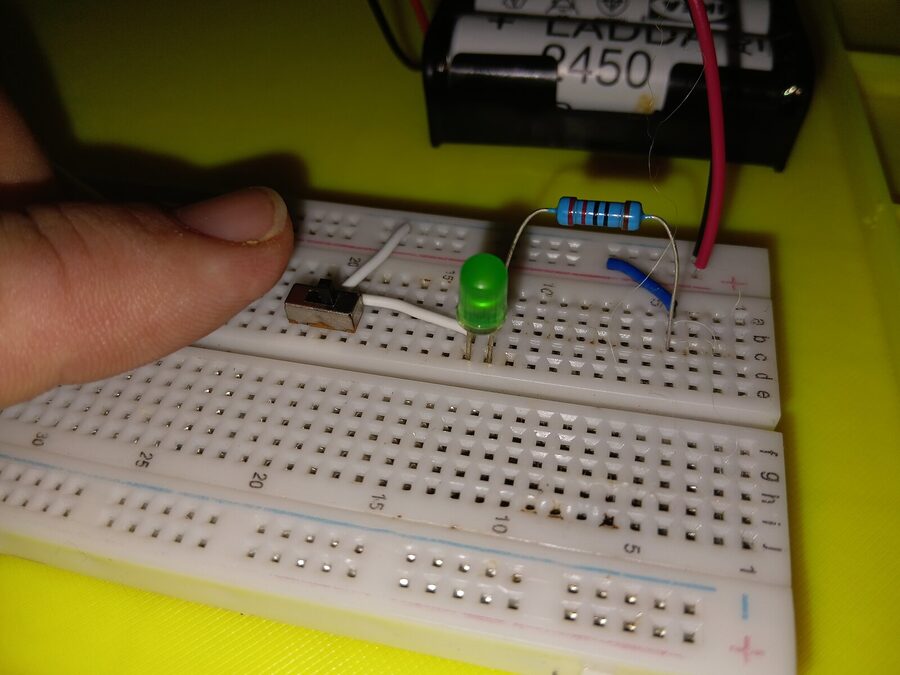
What it actually looks like
No illustrations here — these are from testing the curriculum on our own bench, the same kit and the same builds a class will use.
Why this one, and why now
Better than screen time — a puzzle that tells them when they've got it right. It lights up.
Absorbing in the way a screen is, except they can put it down — they just don't want to.
Thinking hard about small problems is a skill that scales to big ones. So is working tidily — a clear bench, parts where you left them, and a habit of checking before you assume.
Their kit is theirs, so it doesn't stop when the course does.
A working circuit is easy. We teach the method for when it doesn't work — check the middle, halve the problem, keep going. It works on anything that breaks.
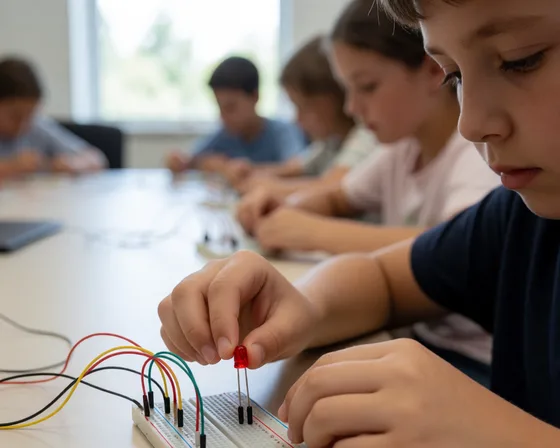
No one has to be made to do this. A circuit that nearly works is the kind of puzzle a child stays with — you'll have to tell them to stop.
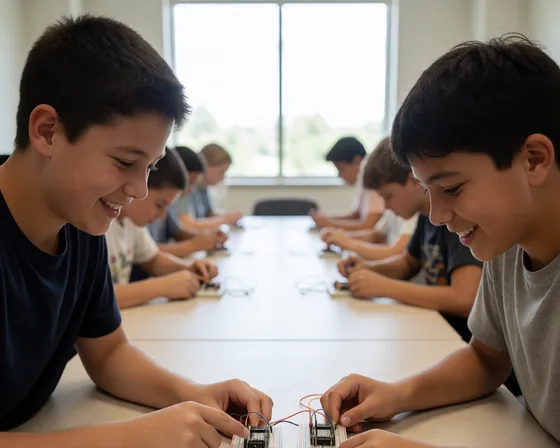
No score, no leaderboard, nothing to come last at. Finishing first promotes you to teacher.
One analogy, used consistently — which means even the failures make sense before they happen.
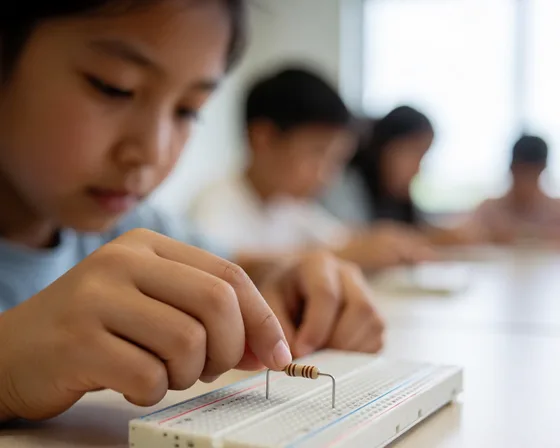
Fingers learn when a wire is properly seated. The eye starts to see the circuit, not a tangle.
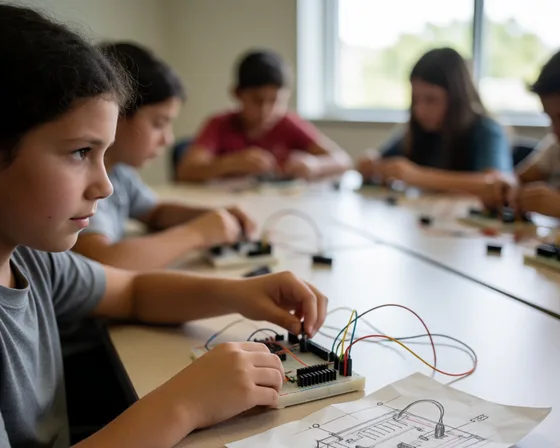
The end goal isn't following instructions. It's the moment a child says "I want to build a thing that does X" and has enough understanding to actually start.
A note from me
At my son's school orientation they made a point that stuck with me. Twenty years ago, none of these were job titles:
There was no way to train for them. There's no way to know what opportunities will be available for our children in twenty years.
Right now we're going through a time of change where AI is transforming industries on a massive scale. The best we can do is raise our children to be:
We try to help with that, guiding our students to solve problems on their own, and expand their skillset. When they get something working, they know it was them.
We're a Gold Coast family business, not a franchise. I live here, my kids go to school here, and I'm the one who'll be teaching your child — the same person every week. Booking a term keeps your money in Queensland, and if something isn't right you can ring me and I'll answer.
What your child actually builds
It starts as a battery and a light, and ends as a device that senses the world and does something about it. The quotes are the sort of thing you hope to hear in the car on the way home.
What it costs
So you can see what you are paying for. The first lesson is free either way, and nothing is owed if it turns out not to suit.
Ten weekly sessions · 4–5pm
$300 for ten sessions
Sixteen experiments, an hour a week, twelve students at most. That works out at $30 an hour, and every experiment sheet is printed and theirs to fill in and keep.
Small enough that I can sit with each child when their circuit will not work — which is most of the teaching.
Bought once · theirs to keep
$150 with a course
A multimeter, a breadboard and the components for all sixteen experiments, with a printed manual and a case to keep it in. $190 on its own.
Students work from their own kit, so nothing has to be pulled apart for the next class. Already have a meter and a breadboard? Bring them and skip it.
Come to the free lesson first. Everything is provided for that one.
The kit they work from
Not a loan, and not shared class equipment. Every experiment is built on their own board and goes home on it, so nothing is half-finished at the end of an hour and nothing gets pulled apart for the next class. $150 with a course, and it keeps working long after the ten weeks are done.
Why it matters: a child who can keep building at home is a child who might still be doing this in five years. That's the actual point.
Safety, plainly
Answered before you have to ask them.
Nothing hot, no fumes, no burns. Everything is push-fit on a breadboard — which is also the point, because it can be pulled apart and rebuilt endlessly. Soldering is a later course, for older students.
Everything runs from a battery pack at the same voltage as a torch. Nothing in the room plugs into a wall socket. This is a hard rule, not a preference.
Class sizes are capped at twelve, because fault-finding is one-to-one work. The one loud demonstration in the course — a capacitor put in backwards — is done by me, at a distance, with the room ventilated and the children well clear. I hold a Queensland Blue Card (working with children), currently being converted to the business version. Happy to talk through supervision and first aid arrangements with any parent who asks.
Questions
Free first lesson
After-school classes, 4–5pm, around Coomera and Pimpama. The first lesson costs nothing and commits you to nothing — come along, do the first experiment, and see whether the room suits your child. Classes are capped at twelve, small enough that I can sit with each child when their circuit won't work. Tell me your suburb and I'll let you know the date and hall as soon as it's set.
Running a school or after-school program? See the information for schools →
I've got your details. I'll email you as soon as dates and a location are set — nothing to pay in the meantime.
Questions before then? hello@emergingengineers.com.au